
18Hiawatha – First Impressions
Disclaimer: I am no 18xx expert, by far. I have by now quite a few games under my belt, but most of them spread out across different titles, as I love to explore new things. Still, as there's usually little information on all the different 18xx games, I would like to provide some insight into how the game felt (to me) and what made it special.
Content
Intro
18USA has become one of my all-time favourite 18xx games. Playing it for the first time was an eye-opener, and even though sometimes I have a hard time committing myself for a 10hour session when the opportunity comes up (rarely enough), when I actually do it I enjoy every minute of it.
Naturally, I started researching if there are shorter variants for it to get a similar experience in a shorter period. And there are! As also mentioned in my initial 18USA review, besides 18Hiawatha, I know of:
- 1877: Venezuela
- 1817WO
- 1817NA
The first hasn't been published or finished its development, and my first contact with it went very poorly. The second, I have no interest in because of its abstract map. And the third one I had no chance trying out, but is listed as still taking 6+ hours.
Since it was also available on 18xx.games, trying out 18Hiawatha was easy, and a first online live session went well and was super quick. So, after we got our yearly 18USA fix at our last 18XX Franken Convention, our monthly 18XX group was ready to try out 18Hiawatha during our next session. This impression is based on that, and my 2 online playthroughs.
📋 What's the game about?
Generally speaking, we do very similar things than in 1817/18USA. You start companies, evaluate all of them, and try to leverage the money you get by shorting overrated companies by investing it in better companies. The big changes are:
- The endgame is triggered when the first 4-trains are purchased. This means the 3-trains are already permanent and the playtime is around four hours, although this could be less for faster players.
- 2-share companies don't exist, and everything can be shorted directly after the company started. Yes, that means shorting starts in the first Stock Round!
- Trains are always bought for face value (bye bye train shuffling).
Given these changes, did we get what we were looking for?
🛤️ The Map
The map shows the region from Milwaukee in the north to Chicago in the south. There are offboard-connections in all corners/sides of the map, while the values change greatly.
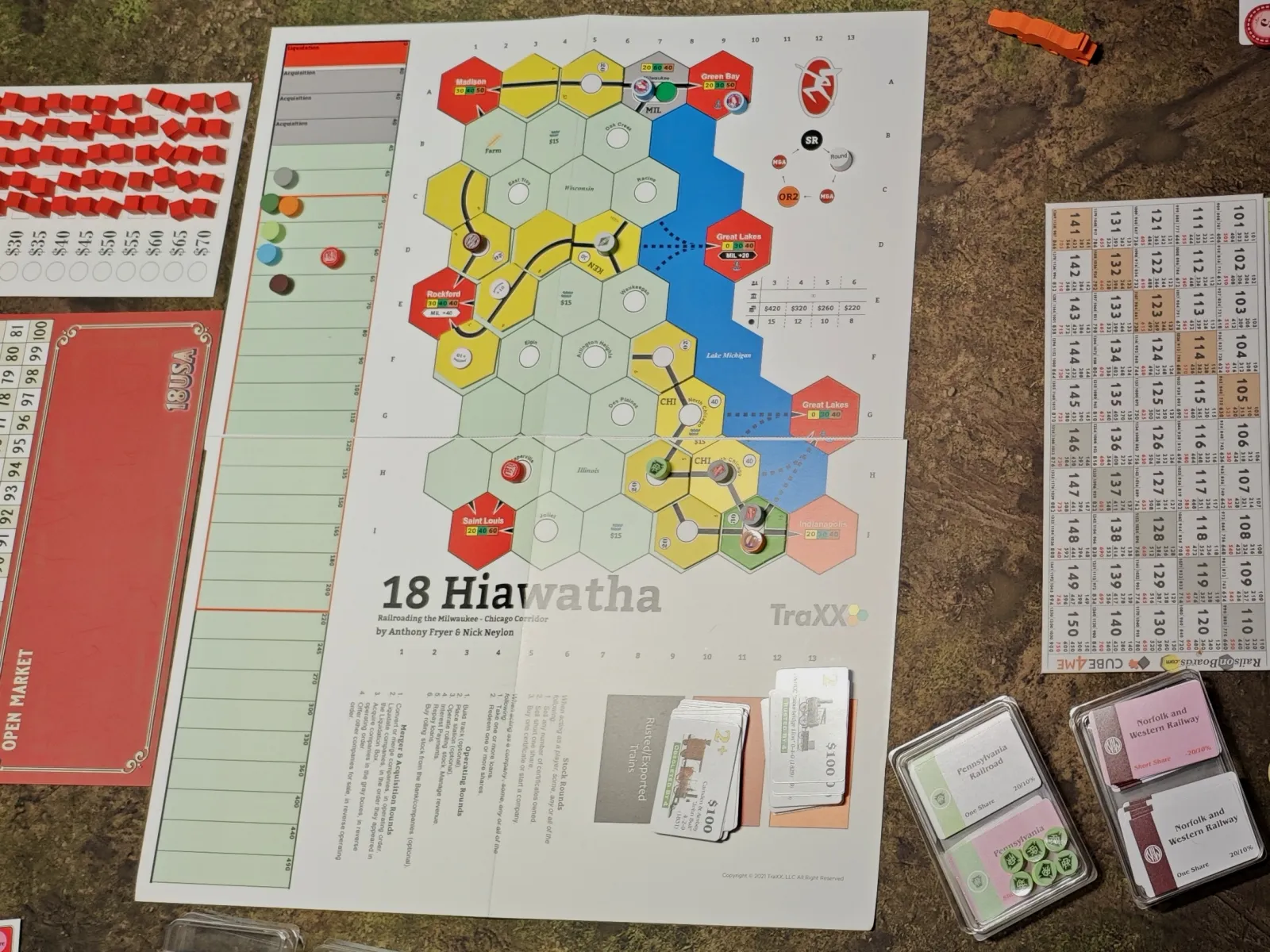
Additional points of interest are the Milwaukee-tile in the North, which is a grey tile that gets a second token spot in green (+60 value) and also is the destination for 2 connection bonuses. One of those can be achieved with a 3-train, the other requires a 4-train.
The two Chicago tiles in the south are special because they start at 40 revenue in yellow, but goes back to 20 in green, to then get to 60 in brown.
The rest of the map doesn't have much features, and also almost no terrain cost. Especially the whole area in the middle north of Chicago has plenty cities, but was very uninteresting/uncontested in our live playthrough.
🏢 The Companies
18Hiawatha uses 12 of the Companies of 1817/18USA, and all Companies start as a 5-share with the purchase of the Director Share. The acquisition of one additional token is mandatory.
Because of this, all companies can be shorted (in contrast to the 2-share companies of 1817/USA), and a lot of thinking goes into which companies have the best positions and how you can screw a company you've shorted even further.
In our playthrough, for example, we were able to exclude a company started in the bottom left from getting to Chicago.
The other big factor are the 8 private companies that are auctioned off at the start of the game and have a nice variety of the stuff you're used to from 1817, like non-upgradeable track tiles with bonuses, special tiles, additional trains, additional revenue tokens, and so on. Making the most of those in combination with the starting position is one of the key elements of a good start in 1817, and definitely can be found here as well.
📈 Values
So clearly, this game should be about values, as you try to parse current with future earnings to determine how you can gain an edge versus your competition. The one rule that really threw me off was the strict sales rule of trains for always face value. I still don't know why it exists, as it makes a lot of strategies existing in the full game irrelevant. There's little value in friendly sales if you can't mess with what you're selling beforehand. If you are shorted, you have fewer options for making those who shorted you pay.
I am sure there's a reasoning for that rule, maybe tied to the shorter playtime and less ORs, but I don't really see the benefit so far. Would be interesting to try without.
On the other hand, this made me realize the benefit of the housekeeping turn that Venezuela introduces, as here, if a new company is opened later at a higher price to pay for the more expensive trains, in a probably worse position because the others are already taken, it becomes a clear short target with little to do, as it surely falls back once and then can only jump forward once max.
After thinking about this now, my preferred solution would probably be the usage of the 18USA up to quadruple jumps, if you stay with the option to short something the minute it opens, as then a lucrative new company that maybe runs the route bonus could do well in its second OR. Still, excluding getting additional trains from other companies seems weird.
🎲 Player Count
So far, I've only played this at 3 players, which was very fine. I totally see this working out at 4. 5 should work as well, but I am bad at projecting this. Maybe it's even more interesting because the money for 2 companies is tighter.
📦 Production
Oh, well. This is a hobby product which cost 30$ at the time (crazy to look at this price after the latest issue clocked in at 90$!) for several games in the magazine. I also think that the magazine is not available at the moment – maybe the digital version still is.

Nevertheless, out of the 16 components (7 track tiles, 8 privates, 1 game map), 4-11 – depending on how you counting – were faulty. That's...not good. The full list is:
- Map / rulebook having different starting money values
- missing brown CHI tile
- very unsharp printing of the privates
- stock market not aligning when putting the map together
Nevertheless, I don't care. The game is perfectly playable. Actually, it was quite revelating to see how little is needed to tune an existing game into something different with just a board and a few paper sheets — given that you need to own a copy for 1817 or 18USA to play this.
💭 Final thoughts
In the end, I am not sure what to make of it. My initial impressions are good. You're definitely getting some of the 1817 vibes, especially at the start. It does start to feel weird when you realise that the 3s are already permanent, and we wondered where the pressure would come from. However, buying the 3s turned out quite stressful on the loan market, and 35$ per loan made surviving — especially once the 2s died — quite challenging. It might have been different if I had not opened one more company, which also bought a 3 but never ran good and was rightfully shorted, but put even more loans into play.
When looking at the BGG comments about 18Hiawatha, I found this comment about 1817 game length and how you need the later trains to make the main decisions around the 3s more opaque. The more I think about it, the more I tend to agree.
Still, I cannot stop hoping for a great, short 1817 like experience. Is it 18Hiawatha? Not to the full extent, but definitely something to start the journey and form an opinion to better understand what it is that drives the main games' perfection. I am happy to have played it.
If you want to want to start your search for a short 1817 like experience but have no player nearby, go check out https://18xx.games/ and start playing online.
For support of the designer/publisher, please head over to Traxx
You should also read:
First impression for 1822PNW
Ok, now it’s getting serious. PNW is probably - SPOILER - my favorite 18xx as of now and I think I played it the most (which means still a lowly 5 times maybe?). Therefore, this is close to my heart and compared to other titles,…
Continue reading...First impression for 18RoyalGorge
#18RoyalGorge surprised me. I had never heard about it and when I looked at the rulebook, the section “hire gunslingers” made me shrug and envision a wargame/western/18xx crossover, where I roll dice when I attack the trains of my competitors. Disclaimer: I am no 18xx…
Continue reading...
1894 - A Plea, not a neutral review
First off… A friend invited me to give 1894 a try. I read the rules and played a round online asynchronously, but I wasn’t very impressed. Well, if it’s that good, then I guess I’ll just have to buy it and try it out at…
Continue reading...